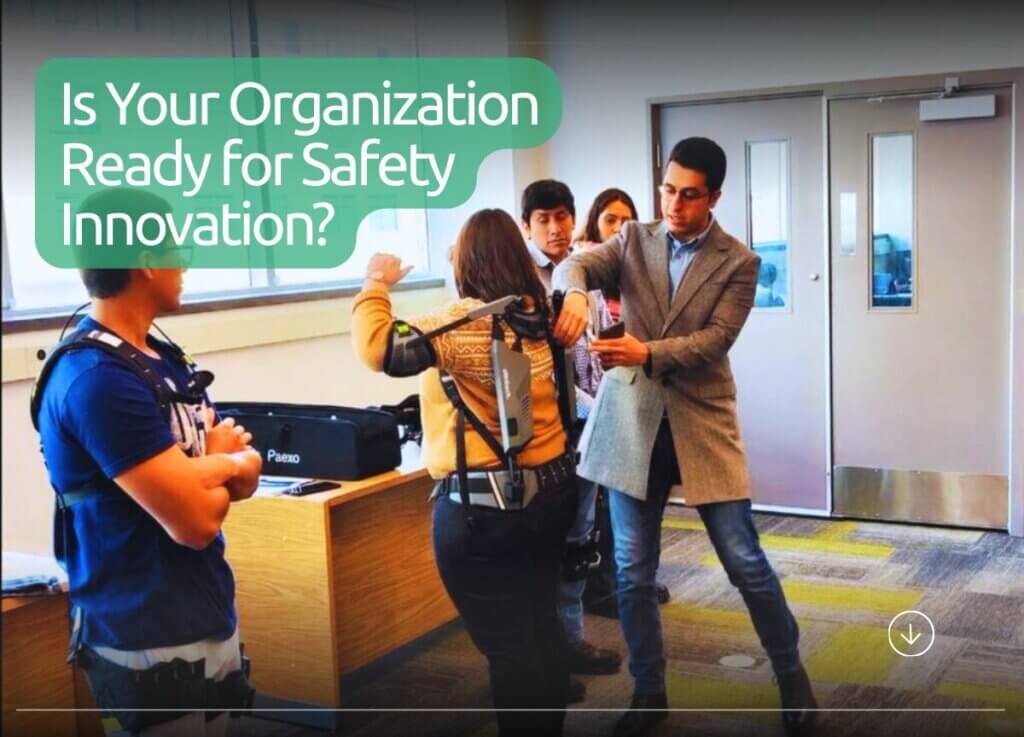
Is Your Organization Ready for Safety Innovation?
New safety technologies are entering the market faster than ever. Artificial Intelligence (AI), motion capture technologies, exoskeletons, sensors, automation, and digital platforms promise better injury prevention, stronger compliance, and improved productivity. Yet many organizations invest in safety innovations that never fully deliver, stall after a pilot, or quietly fade away.
In my years of experience with evaluation and adoption of emerging technologies, the challenge is rarely the technology itself. The real issue is readiness. Successful safety innovation requires clarity about the problem, fit with real work, and a deliberate path from trial to sustained use.
Below is a simple, structured framework developed to help organizations evaluate and adopt safety innovations effectively.
Identify the Problem
Effective safety innovation starts with the hazard or risk, not the solution.
Organizations often approach innovation backwards by starting with a new tool and searching for a place to use it. This almost always leads to misalignment and frustration.
Instead, begin by clearly defining the safety problem:
- What task or activity is involved?
- Where and when does the risk occur?
- Who is exposed?
- What evidence supports this being a real and recurring issue?
Incident reports, near misses, observations, and worker feedback are critical inputs at this stage.
Assess the Innovative Solution
Once the problem is well defined, evaluate whether a proposed innovation genuinely addresses it.
This assessment goes beyond marketing claims. It requires understanding how the technology works in practice and whether it fits your operational reality.
Important considerations include:
- Does the technology directly reduce the identified risk?
- Has it been used successfully in similar environments?
- Is it compatible with existing workflows and equipment?
- What training, support, and change management are required?
- Are costs reasonable relative to expected benefits?
Even the most technically impressive solution will not be used if it does not fit the work.
Pilot, Test, and Evaluate
Piloting is where many innovation efforts either succeed or fail.
A strong pilot is focused, time limited, and tied to clear success criteria. It is not about proving the technology is perfect, but about learning how it performs in real conditions.
Good pilots typically include:
- One site, crew, or task
- Clear measures of success such as risk reduction, usability, compliance, or efficiency
- Both quantitative data and worker feedback
- Honest assessment of limitations and required refinements
If lessons are not being captured, the pilot is not doing its job.
Plan for Implementation
A successful pilot does not automatically lead to successful adoption.
Implementation requires planning for scale, sustainability, and long-term ownership. Without this step, even proven solutions can fail.
Key elements of implementation planning include:
- Defined roles and responsibilities
- Training and onboarding plans
- Leadership support and accountability
- Maintenance, monitoring, and continuous improvement processes
Safety innovation should become part of normal operations, not an ongoing special project.
Readiness Matters More Than the Tool
Across many projects, we see the same pattern. Organizations that succeed with safety innovation ask hard questions early, involve workers and supervisors, and treat adoption as a system change rather than a purchase.
A few readiness questions we often emphasize include:
When the answers to these questions are positive, innovation efforts are far more likely to deliver real safety outcomes.
Final Thought
Safety innovation is not about chasing the newest technology. It is about making thoughtful decisions that improve how work is done and how people are protected.
A structured approach helps organizations move from interest to impact with confidence.